NIH: Harder Secures New Support for Science Innovation Bill from NIH Director
New “X-Labs” Initiative will bring startup research model to NIH for first time ever
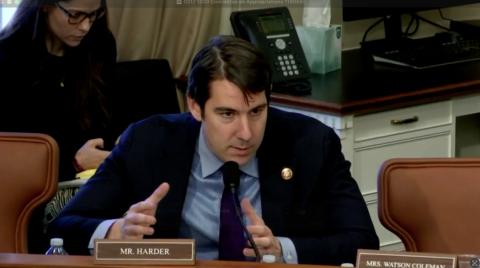
VIDEO: NIH Director highlights need for high-risk, high-reward science
WASHINGTON – This week, Rep. Josh Harder (CA-09) secured new support from the National Institutes of Health (NIH) Director Dr. Jay Bhattacharya for his bipartisan bill to bring an ambitious startup research model to the world’s top science agency. Director Bhattacharya appeared before the House Appropriations Subcommittee on Labor, Health and Human Services, Education, and Related Agencies Wednesday for an oversight hearing and highlighted the need for high-risk, high reward investment reforms at NIH.
At the hearing, Harder drew attention to how the NIH has long been the engine for prosperity in the U.S., driving discoveries that have saved millions of lives and helping establish decades of American biomedical dominance, but also how that leadership has started to fade. Chinese institutions now publish more scientific research papers annually than the United States, and their share of highly-cited medical research has risen rapidly.
Harder’s bipartisan Launching X-Labs for Breakthrough Science Act, led with Rep. Jay Obernolte (CA-23) addresses that challenge by bringing a proven model of high-risk, high-reward scientific exploration to NIH for the first time ever, across a four-part funding series:
- Foundational Discovery (XL01) – Funding independent research organizations that produce new and major scientific discoveries.
- Toolbuilding (XL02) – Research focused on identifying gaps in tools and infrastructure used in scientific discovery.
- Biomedical Regranting (XL03) – Empowering scientific scouts to spot promising biomedical research.
- New Institutions (XL04) – Seeding new institutions at the forefront of future scientific research.
Director Bhattacharya called the initiative “an innovative idea” that he would be “very interested to work together on” and highlighted the need for reforms to “[make] sure that the United States remains the forefront of biomedicine.”
Read the full transcript below:
HARDER: “I think about trying to make sure that we are moving beyond some of the constraints of the typical NIH process to do things like use large, interdisciplinary teams, use ample funding to really curate datasets and computational resources that are greater than any one lab would be able to do, and give sustained funding over a really long time horizon.
“I’ve worked on a bill that we’ve discussed on this topic called ‘Launching X-Labs for Breakthrough Science’ with Congressman Obernolte to do that, trying to give the NIH the ability to give long-term, large grants to interdisciplinary teams advancing transformational research.
“I’d love to get your take on if you think there’s a role for that and what we can do to try to make sure we’re advancing priorities like this?”
DIRECTOR BHATTACHARYA: “Congressman Harder, I really enjoyed our time to talk about this because I think those kinds of innovative ideas in accelerating the NIH’s investments in early care researchers, in high-risk, high-reward science - it’s going to take a different way of doing things than how we normally do things.
“I’d be delighted to work with you and your staff and others who are similarly minded. As I’ve said to folks, the opportunities are incredible. There are so many American scientists with great ideas, great training.
“I also agree with entirely your characterization of the Chinese challenge - the Chinese biomedical research capacities have grown tremendously in part because of American investments.
“So working on making sure that the United States remains the forefront of biomedicine is going to take a lot of new thinking - I know you’re working on X-Labs, on early care researchers - I’m very interested to work together on all of those opportunities.”
Watch the full discussion here.
###